
 Tweet
Tweet
Originally posted by Brian Bushnell
View Post
-
The X series uses the standard 4-dye chemistry. NextSeq is the only one to use 2-dye. (And the one that people seem to be having the most problems with in terms of quality...) -
More like Intel model. e.g. socket LGA2011 --> LGA2011-v3 (not backwards compatible).Originally posted by austinso View PostComment
-
Pretty sure they will initially only support 2x125 in 3.5 daysComment
-
"The 3000 is to the 4000 as the 1000 was to the 2000 and the 1500 to the 2500" Nice summary here: https://biomickwatson.wordpress.com/...00-in-context/
- GenohubComment
-
The one difference with these machines is the throughput. A university facility needed 2 flow cells that could be run independently to help manage a queue, since a paired end run would be almost two weeks (less now). But if most runs are 1-3 days, then that is less of a problem. I suspect the 3000 won't be substantially cheaper so it won't be appealing since you might as well get twice the capacity for a little extra, but some of the other reasons are less important for these machines.Providing nextRAD genotyping and PacBio sequencing services. http://snpsaurus.comComment
-
I know nobody here cares about microarrays (nor should we?), but I think Illumina deserves some serious mad-scientist points for the NextSeq 550. If I'm understanding correctly, they've made a microarray adapter that fits in the flow-cell slot, and are reading it with the same scanner. More innovation than I'd expect from a company with a secure monopoly.
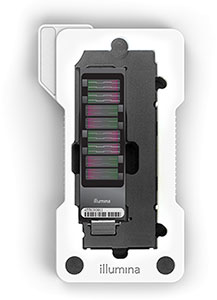
Maybe this is an attempt to wean the last few stragglers off arrays and get them into sequencing?Comment
-
Can these new flow cells still be overloaded, or has Illumina created the ideal clustering procedure? Just load your library at high concentration for maximal occupance of the flow cell "wells" and skip qPCR and titration.....
Anything known about the clustering procedure yet?Comment
-
Remembering back to the HiseqX announcement the little holes that now hold the clustering oligos (which is why this is a "patterned" flowcell) allow 1 oligo to overpower any others that try to cluster in there. I suppose you could somehow get it to overcluster but it wouldn't be the same kind of overclustering we are used to.
Clustering still appears to be on the cBot.
Here's some back-of-excel calcs I did on prices posted for the new 3k/4k reagents. Throughput assumptions are made based on average numbers given by Illumina in their specs and 8-lane FCs.
Comment
-
They still need to be quantified. Assuming similarity of HiSeq 4000 flow cell to HiSeq x, they can be overloaded which will reduce the reads %PF. Low loading will increase the number of duplicate reads. Illumina manual also states that underloading can reduce or result in unacceptable %PF. Loading is depend on library type (Nano or PCR-free).Originally posted by HeinKey View PostComment
-
No rapid mode is a bummer for HiSeq 4000. I hope they can add that later.
I also want an upgrade of MiSeqComment
-
Looks like there will be a V2 chemistry coming soon for NextSeq. Illumina claimed that the error rate can be on par with MiSeq/HiSeq. Hope this is true. This can be a nice upgrade for MiSeq.
HiSeq 4000 is quoted at $900K and 2500 is reduced to $690K. Both are more expensive than I expect.Comment
-
I asked Illumina and was told not. Apparently the cameras are more sensitive.Originally posted by HeinKey View Post
Also, the NextSeq550 capability for arrays is currently limited to the methylation and karyomapping chips, not sure why. They have suggested they may look into allowing iSelect if enough users are interested. Personally, I feel it would be a good move - core labs could use the NextSeq as a stopgap for priority NGS/genotyping runs if the HiSeqs/iScans are at capacity or down for repair.Comment
-
I see NextSeq V2 kits here claiming better error rate than v1. Is it true?
The throughput is the same??Comment
-
just visited an Illumina meeting in Brussels.
Current HiSeqs are not upgradable to the 3000 or 4000 versions. Hardware is too different between the systems.
4000 and 3000 can only sequence Human DNA with certain fragment length. WGS, exome and RNAseq will work well, other library types are not supported due to the limitations of the new exclusion amplification kinetics.
New NextSeq V2 chemistry was presented. New dyes in the V2 kits with much less spectral overlap compared to the V1 dyes. Discrimination between dyes is much better resulting in higher quality reads and lower error rates. Now comparable with their four dye chemistry.
All in all very informative again.Comment


-
Proteomics platforms are evolving rapidly, with advances in mass spectrometry and affinity-based approaches expanding what researchers can detect and at what scale. As the field moves toward deeper proteome coverage and clinical applications, scientists face an increasingly complex landscape of tools. This article will explore how researchers are navigating these choices to find the right platform for their work.
The systematic characterization of the human proteome has...07-20-2026, 11:48 AM -
Genomics studies in neuroscience face a special challenge due to the brain’s complexity and scarcity of samples. Mapping changes in cell type and state using conventional next-generation sequencing methods remains challenging. Advances in technologies like single-cell sequencing, spatial transcriptomics, and long-read sequencing have opened the door to deeper studies of the brain and diseases like Alzheimer’s, amyotrophic lateral sclerosis (ALS), and schizophrenia.
...07-09-2026, 11:10 AM -
Cancer survival rates have significantly increased in the last few decades in the United States, reaching a combined 70% 5-year survival rate by 2021. Behind this number, there are years of research to find new therapies, drug targets, and early detection methods. But there is one core challenge that keeps slowing down these advances, and it’s about drug resistance.
There is no single reason why many patients don’t respond to treatment as expected. Cancer is...07-08-2026, 05:17 AM
Comment