Unconfigured Ad

Collapse
X
 
  • Filter
  • Time
  • Show
Clear All
new posts
  • rndouglas
    Member
    • Jun 2012
    • 23

    Bowtie mapping with more than 3 mismatches?

    I'm trying to map some sRNA reads to specific loci of interest while allowing up to 3 mismatches using -v 3.

    For some of my target loci, this seems to work well. All of the mapped reads have no more than 3 mismatches.

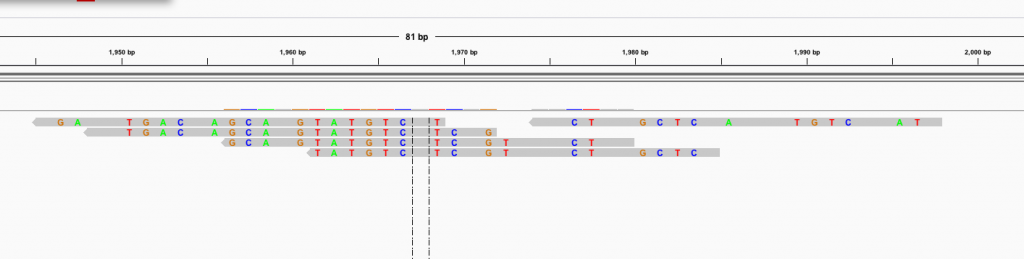
    However, when I use the exact same code, changing only the bowtie files for a new locus, I'll get reads with up to 20 mismatches (and the sRNA read is only 24nt long!).

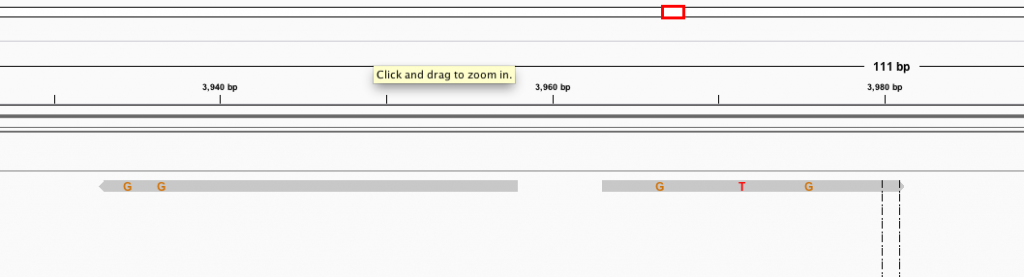
    I've attached two screenshots from IGV showing the same sRNA sample mapped with Bowtie against two different loci. All of the nucleotides shown are mismatches.

    How I expect it to always look:

    How it usually turns out:

    The code I'm using is as follows:

    Code:
    bowtie -f -v 3 -S ~/CRM2 ~/sRNA.fa > ~/output.sam
    Oddly, I also have the exact same issue (too many mismatches) when I use this code:
    Code:
    bowtie -f -n 0 -l 25 -S ~/CRM2 ~/sRNA.fa > ~/output.sam
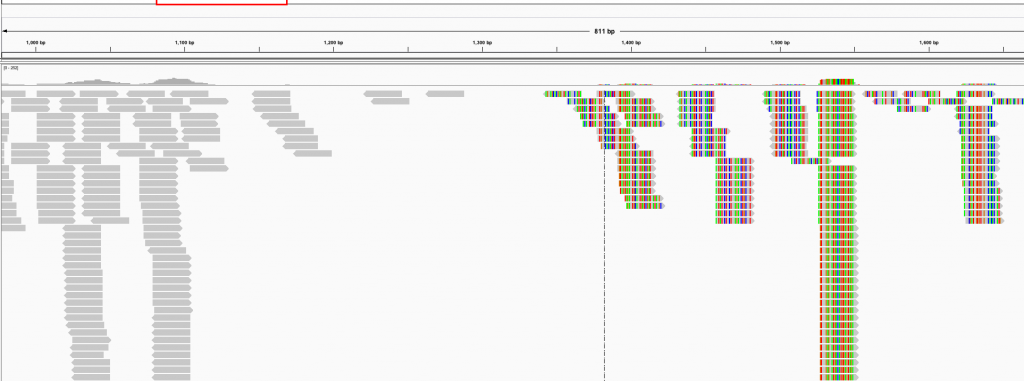
    Am I doing something wrong? Has anyone else seen this?
  • rndouglas
    Member
    • Jun 2012
    • 23

    #2
    Cranking up the frustration a notch....

    This week I discovered the same situation (up to 20 mismatches on a 24 nt "mapped" read) occurs when I set -v to 0, supposedly not allowing for mismatches.


    This happens with ~4-5 loci I'm interested in mapping to, but several other loci of similar length do not show this problem at all.

    Comment

    • Nepher
      Junior Member
      • Jan 2013
      • 4

      #3
      Have the same problem

      Hi all,

      since this thread has no answer and that I came across exact the same issue I wanted to know if someone knows how this type of alignment is possible. Where is the mistake ?
      I also have 24 mismatches on sequences that were mapped with NO mismatch option...

      If you could help I would be very grateful

      Thanks a lot

      Comment

      • rndouglas
        Member
        • Jun 2012
        • 23

        #4
        For me, it was an issue with IGV. When I looked more closely IGV was coloring nucleotides as being mismatched, but they really were not mismatched. I never found a workaround/explanation, so I just had to ignore all of the claimed mismatches.

        Bowtie was mapping properly with zero mismatches allowed.

        Comment

        • Nepher
          Junior Member
          • Jan 2013
          • 4

          #5
          Thanks for your answer.

          I came across a solution this morning. After checking lots of stuff I looked again at my reference sequence and I saw that there were special characters at the beginning of the sequence :

          >name
          ??????ATCGTGCTA

          I simply erased them and IGV removed the most part of mismatches (it left those from the mapping). I think that the mapping coordinates where simply shifted/reference sequence.

          Hope this will help other users with IGV problems

          Comment

          Latest Articles

          Collapse

          • SEQadmin2
            Proteomic Platforms: How to Choose the Right Analytical Strategy to Improve Detection and Clinical Applications
            by SEQadmin2


            Proteomics platforms are evolving rapidly, with advances in mass spectrometry and affinity-based approaches expanding what researchers can detect and at what scale. As the field moves toward deeper proteome coverage and clinical applications, scientists face an increasingly complex landscape of tools. This article will explore how researchers are navigating these choices to find the right platform for their work.

            The systematic characterization of the human proteome has
            ...
            07-20-2026, 11:48 AM
          • SEQadmin2
            Advanced Sequencing Platforms Tackle Neuroscience’s Toughest Genomics Problems
            by SEQadmin2


            Genomics studies in neuroscience face a special challenge due to the brain’s complexity and scarcity of samples. Mapping changes in cell type and state using conventional next-generation sequencing methods remains challenging. Advances in technologies like single-cell sequencing, spatial transcriptomics, and long-read sequencing have opened the door to deeper studies of the brain and diseases like Alzheimer’s, amyotrophic lateral sclerosis (ALS), and schizophrenia.
            ...
            07-09-2026, 11:10 AM
          • SEQadmin2
            Cancer Drug Resistance: The Lingering Barrier to Rising Survival
            by SEQadmin2


            Cancer survival rates have significantly increased in the last few decades in the United States, reaching a combined 70% 5-year survival rate by 2021. Behind this number, there are years of research to find new therapies, drug targets, and early detection methods. But there is one core challenge that keeps slowing down these advances, and it’s about drug resistance.

            There is no single reason why many patients don’t respond to treatment as expected. Cancer is...
            07-08-2026, 05:17 AM

          ad_right_rmr

          Collapse

          News

          Collapse

          Topics Statistics Last Post
          Started by SEQadmin2, 07-20-2026, 11:10 AM
          0 responses
          18 views
          0 reactions
          Last Post SEQadmin2  
          Started by SEQadmin2, 07-13-2026, 10:26 AM
          0 responses
          33 views
          0 reactions
          Last Post SEQadmin2  
          Started by SEQadmin2, 07-09-2026, 10:04 AM
          0 responses
          44 views
          0 reactions
          Last Post SEQadmin2  
          Started by SEQadmin2, 07-08-2026, 10:08 AM
          0 responses
          30 views
          0 reactions
          Last Post SEQadmin2  
          Working...