Unconfigured Ad

Collapse
X
 
  • Time
  • Show
Clear All
new posts
  • kmcarr
    Senior Member
    • May 2008
    • 1181

    #16
    Victor,

    Run GERALD including the following line in the GERALD configuration file:

    QF_PARAMS '(1==1)'

    This is a conditional which is true 100% of the time; in other words, GERALD passes every read.

    (This technique comes from the Pipeline User Guide)
    Last edited by kmcarr; 10-07-2008, 09:44 AM. Reason: To correct line and add attribution.

    Comment

    • ShaunMahony
      Member
      • Apr 2008
      • 27

      #17
      As said below (and also in the Solexa documentation), Solexa quality scores in their Fastq-like format are given by 10*log_10(P/(1-P)). I thought it might be useful for some people if I posted a lookup table based on this. Note I'm giving the probability that a base is erroneous, rounded to four decimal places. Please post a reply if you think this table is an incorrect translation:

      Char ASCII Char-64 P(error)
      ; 59 -5 0.7597
      < 60 -4 0.7153
      = 61 -3 0.6661
      > 62 -2 0.6131
      ? 63 -1 0.5573
      @ 64 0 0.5000
      A 65 1 0.4427
      B 66 2 0.3869
      C 67 3 0.3339
      D 68 4 0.2847
      E 69 5 0.2403
      F 70 6 0.2008
      G 71 7 0.1663
      H 72 8 0.1368
      I 73 9 0.1118
      J 74 10 0.0909
      K 75 11 0.0736
      L 76 12 0.0594
      M 77 13 0.0477
      N 78 14 0.0383
      O 79 15 0.0307
      P 80 16 0.0245
      Q 81 17 0.0196
      R 82 18 0.0156
      S 83 19 0.0124
      T 84 20 0.0099
      U 85 21 0.0079
      V 86 22 0.0063
      W 87 23 0.0050
      X 88 24 0.0040
      Y 89 25 0.0032
      Z 90 26 0.0025
      [ 91 27 0.0020
      \ 92 28 0.0016
      ] 93 29 0.0013
      ^ 94 30 0.0010
      _ 95 31 0.0008
      ` 96 32 0.0006
      a 97 33 0.0005
      b 98 34 0.0004
      c 99 35 0.0003
      d 100 36 0.0003
      e 101 37 0.0002
      f 102 38 0.0002
      g 103 39 0.0001
      h 104 40 0.0001

      Comment

      • vruotti
        Member
        • Feb 2008
        • 13

        #18
        More on Quality

        Hello,
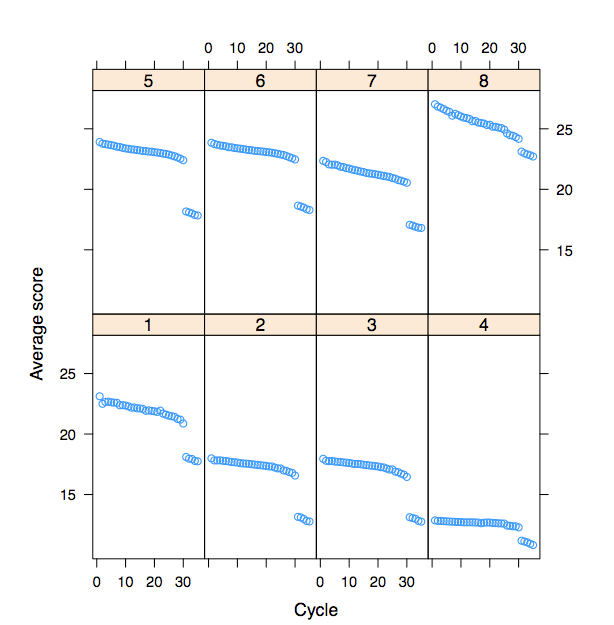
        We are looking a little closer at the quality of one of our runs. Interestingly, we see a pattern in most of our runs right at the 30th cycle. The information from the graph below comes from the s_N_export.txt files. Please ignore the graph from lane 4. This was a failed lane. The others however, including our control (lane 8) show this pattern.

        This was an IPAR run with the upgraded GAII and was one of our best runs. Other runs also show this pattern at the 30th cycle. Does anyone know the reason why the qualities drop so much after the 30th cycle? Have you seem this before in any of your runs?

        Thanks in advance.
        Victor
        Last edited by vruotti; 10-10-2008, 01:52 PM.

        Comment

        • TylerBackman
          Member
          • Oct 2008
          • 13

          #19
          Originally posted by vruotti View Post
          Does anyone know the reason why the qualities drop so much after the 30th cycle?
          This is most likely because the qualities you are looking at are alignment normalized, and a large number of your sequences failed to align to the reference genome (due to a ligated adapter, etc.)

          Take a look at the un-normalized scores (s_<lane>_qraw.txt) instead, I think you'll find that the curve is more continuous between cycles.
          @1
          NNNNNNNNNNNNNNNNNNNNNNNNNNNNNNNNNNNN
          +
          """"""""""""""""""""""""""""""""""""

          Comment

          • baohua100
            Senior Member
            • Jun 2008
            • 103

            #20
            fastq file:
            @I326_2_FC306FCAAXX:8:1:50:985
            ATGTCCGAAGGGCAGTCTCAAGTGGTAAAATGGAT
            +I326_2_FC306FCAAXX:8:1:50:985
            hhhWhhhchhhhhahShh\PO]LgXZXPNLUTZNO


            MAQ alignment output:

            I326_2_FC306FCAAXX:8:1:50:985 1 1 + 0 0 99 99 99 0 0 1 0 35 ATGTCCGAAGGGCAGTCTCAAGTGGTAAAATGGAT ```W```````````S``\PO]L`XZXPNLUTZNO

            what's the meaning of ```W```````````S``\PO]L`XZXPNLUTZNO ?

            not the same as hhhWhhhchhhhhahShh\PO]LgXZXPNLUTZNO

            Comment

            • baohua100
              Senior Member
              • Jun 2008
              • 103

              #21
              Now we get new solexa data:

              @7_1wo1J99L221/1
              GGAGTTGGGGTTCAGATGAAGNAGAGAAAGACCGTAGAAGTTCA
              +
              UUUUUUUUUUUUUUUQUUUUUEQUQUMMUUPUUUPMPMPPJPPP
              @7_Xwo1J99L221/1
              GTGTGAAGGTAACCGTAATGTNTGTTGACAAACGCCGTAACGAT
              +
              UUUQUORRURUUUUUUUUUUUEUUUUUQUUUNNEUPPPPPPPGP
              @3_avo1J99L221/1
              CAGGGATGGGATATAGTTTGCNTCGGTTTTAATAGTTGGGGGAG
              +
              UOUUSUUUUUUUUUUURUUUUEUUUUUUUUUUOUUPPPPPPPPP
              @7_vuo1J99L221/1
              GATGATGATGATGATGAGCTTNTCACTCGACGGTCACAGGCTTT
              +
              UUUUMUUUUUQUUUUUUUUUUEUUUUUUURUUUPUPPPPPPPMP


              the most of char is U , how about this quality score mean ?

              Comment

              • bioinfosm
                Senior Member
                • Jan 2008
                • 483

                #22
                Z is better and higher score than U..
                More infor here - http://maq.sourceforge.net/fastq.shtml
                --
                bioinfosm

                Comment

                • BAJ
                  Member
                  • Nov 2008
                  • 15

                  #23
                  conversion table for solexa and Phred

                  I found this table useful it contains both scores for solexa and phred...


                  It is in PDF fromat...

                  Comment

                  • seq_GA
                    Senior Member
                    • Feb 2009
                    • 124

                    #24
                    How to compare eland and maq quality score?
                    How to read maq quality score?
                    Thanks.

                    Comment

                    Latest Articles

                    Collapse

                    • SEQadmin2
                      Beyond CRISPR/Cas9: Understand, Choose, and Use the Right Genome Editing Tool
                      by SEQadmin2


                      CRISPR/Cas9 sparked the gene editing revolution for both research and therapeutics.1 But this system still showed severe issues that limited its applications. The most prominent were the heavy reliance on PAM sequences, delivery limitations, double-stranded breaks that prompt unintended edits and cell death, and editing inefficiency (both in targeting and in knock-in reliability).

                      Despite this, “CRISPR helped turn genome editing from a specialized technique into
                      ...
                      Today, 11:01 AM
                    • SEQadmin2
                      Proteomic Platforms: How to Choose the Right Analytical Strategy to Improve Detection and Clinical Applications
                      by SEQadmin2


                      Proteomics platforms are evolving rapidly, with advances in mass spectrometry and affinity-based approaches expanding what researchers can detect and at what scale. As the field moves toward deeper proteome coverage and clinical applications, scientists face an increasingly complex landscape of tools. This article will explore how researchers are navigating these choices to find the right platform for their work.

                      The systematic characterization of the human proteome has
                      ...
                      07-20-2026, 11:48 AM
                    • SEQadmin2
                      Advanced Sequencing Platforms Tackle Neuroscience’s Toughest Genomics Problems
                      by SEQadmin2


                      Genomics studies in neuroscience face a special challenge due to the brain’s complexity and scarcity of samples. Mapping changes in cell type and state using conventional next-generation sequencing methods remains challenging. Advances in technologies like single-cell sequencing, spatial transcriptomics, and long-read sequencing have opened the door to deeper studies of the brain and diseases like Alzheimer’s, amyotrophic lateral sclerosis (ALS), and schizophrenia.
                      ...
                      07-09-2026, 11:10 AM

                    ad_right_rmr

                    Collapse

                    News

                    Collapse

                    Topics Statistics Last Post
                    Started by SEQadmin2, Today, 02:55 AM
                    0 responses
                    7 views
                    0 reactions
                    Last Post SEQadmin2  
                    Started by SEQadmin2, 07-24-2026, 12:17 PM
                    0 responses
                    11 views
                    0 reactions
                    Last Post SEQadmin2  
                    Started by SEQadmin2, 07-23-2026, 11:41 AM
                    0 responses
                    12 views
                    0 reactions
                    Last Post SEQadmin2  
                    Started by SEQadmin2, 07-20-2026, 11:10 AM
                    0 responses
                    24 views
                    0 reactions
                    Last Post SEQadmin2  
                    Working...