Unconfigured Ad

Collapse
X
 
  • Filter
  • Time
  • Show
Clear All
new posts
  • zgene
    Junior Member
    • Sep 2012
    • 8

    Bioanalyzer for ChIPed DNA

    Dear All,
    I have a question regarding bioanalyzer for ChIPed DNA.
    When I do bioanalyzer for the input DNA, I get peaks at the proper range in bioanalyzer.
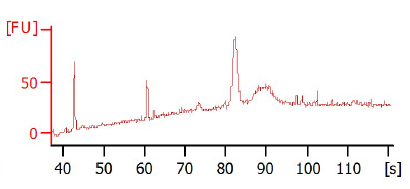
    But, for the immunoprecipitated samples, I got no peaks at all or strange peaks. I even do not have the marker peaks!
    I should mention that the concentration of ChIPed DNA was as low as 0.3 ng/µl (measured by Qubit HS kit) and I used 1 µl for bioanalyzer. So, I expected very low signals in bioanalyzer, but literally got nothing.
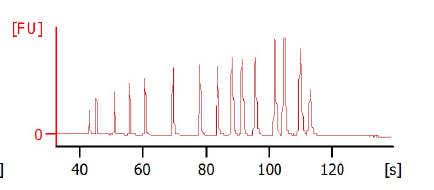
    These samples were loaded in a same bioanalyzer chip used for some other library prepped samples and they all worked well, which shows that there was no problem in bioanalyzer chip or experiment.
    Can anyone help me how to explain this?
    I am totally confused and cannot figure out what I should do!
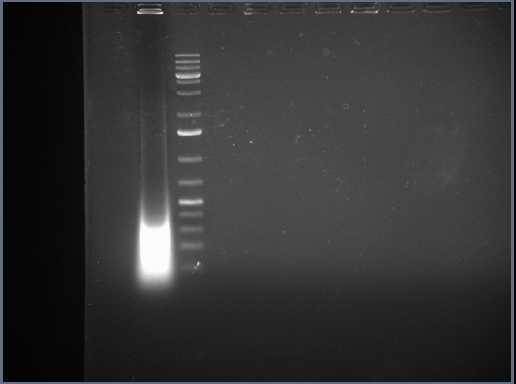
    In the attached you can find a gel photo of the sonicated chromatin as well as two bioanalyzer graphs of two different ChIPed samples.

    waiting for your replies...
    Click image for larger version

Name:	Ladder.png
Views:	1
Size:	27.0 KB
ID:	309065


    Click image for larger version

Name:	ChIPed Sample12.png
Views:	1
Size:	29.6 KB
ID:	309066

    Click image for larger version

Name:	gel photo after sonication.jpg
Views:	1
Size:	10.3 KB
ID:	309067
    Attached Files
    Last edited by zgene; 06-13-2016, 12:21 PM.
  • nucacidhunter
    Jafar Jabbari
    • Jan 2013
    • 1250

    #2
    It seems that one of the wells was not loaded with marker and the strange peak in other well could be due to contaminants from immunoprecipitation step. I could not figure which Bioanalyser trace is from input DNA.

    Comment

    • zgene
      Junior Member
      • Sep 2012
      • 8

      #3
      Originally posted by nucacidhunter View Post
      It seems that one of the wells was not loaded with marker and the strange peak in other well could be due to contaminants from immunoprecipitation step. I could not figure which Bioanalyser trace is from input DNA.

      Dear nucacidhunter,

      Thanks for the reply.
      Marker was loaded in all the wells.
      I did not attach the Input traces there, there was only a gel photo for that.
      The Input traces are now attached here.
      Click image for larger version

Name:	input.png
Views:	2
Size:	36.8 KB
ID:	305104
      For the contaimnation, I should say that I used the columns available in the kit (Abcam high sensitivity ChIP kit) which includes 3 washing steps with ethanol after DNA binding to the column.
      Do you think that its better to replace this step with qiagen kit to get less contaminants?

      Comment

      • nucacidhunter
        Jafar Jabbari
        • Jan 2013
        • 1250

        #4
        I would contact kit supplier before trying another column for clean up. It could be result of some inefficiency at steps prior to clean up. Sample showing no trace in BA should be rerun to make sure that it is reproducible.

        Comment

        Latest Articles

        Collapse

        • SEQadmin2
          Nine Things a Sample Prep Scientist Thinks About Before Sequencing
          by SEQadmin2


          I’m not a sequencing expert. I’m a purification scientist who uses NGS to evaluate workflows my group develops. With this perspective, we think about the sample first and the NGS workflow second. The sequencer is an exceptionally honest reporter, but it can only report on what you give it, so whether you get clean, interpretable data from an NGS workflow is largely determined before you begin.


          Here are nine questions we think about, in roughly the order they matter, before...
          Today, 07:11 AM
        • SEQadmin2
          From Collection to Sequencing: Why Sample Preparation and Preservation Define Sequencing Data
          by SEQadmin2


          Data variability is still an issue in sequencing technologies despite the advances in reproducibility and accuracy of these platforms. But the problem does not originate in the sequencing itself, but in the previous steps, before the sample reaches the sequencer.


          The first step is collection, followed by preservation and sample preparation for analysis. Most scientists overlook those steps, but not being careful might just be skewing the experiment’s results.
          ...
          06-02-2026, 10:05 AM
        • SEQadmin2
          Single-Cell Sequencing at an Inflection Point: Early Impacts of New Platforms and Emerging Trends
          by SEQadmin2


          With the launch of new single-cell sequencing platforms in 2026, the field stands at an exciting inflection point. This article surveys the most impactful advances in the field and discusses how they’re reshaping research in cancer, immunology, and beyond.


          Introduction

          Single-cell sequencing technologies have undergone remarkable advances over the past decade, transitioning from low-throughput experimental approaches to highly scalable platforms capable of...
          05-22-2026, 06:42 AM

        ad_right_rmr

        Collapse

        News

        Collapse

        Topics Statistics Last Post
        Started by SEQadmin2, Yesterday, 06:09 AM
        0 responses
        16 views
        0 reactions
        Last Post SEQadmin2  
        Started by SEQadmin2, 06-09-2026, 11:58 AM
        0 responses
        37 views
        0 reactions
        Last Post SEQadmin2  
        Started by SEQadmin2, 06-05-2026, 10:09 AM
        0 responses
        42 views
        0 reactions
        Last Post SEQadmin2  
        Started by SEQadmin2, 06-04-2026, 08:59 AM
        0 responses
        49 views
        0 reactions
        Last Post SEQadmin2  
        Working...