Unconfigured Ad

Collapse
X
 
  • Filter
  • Time
  • Show
Clear All
new posts
  • ecSeq Bioinformatics
    Senior Member
    • May 2012
    • 492

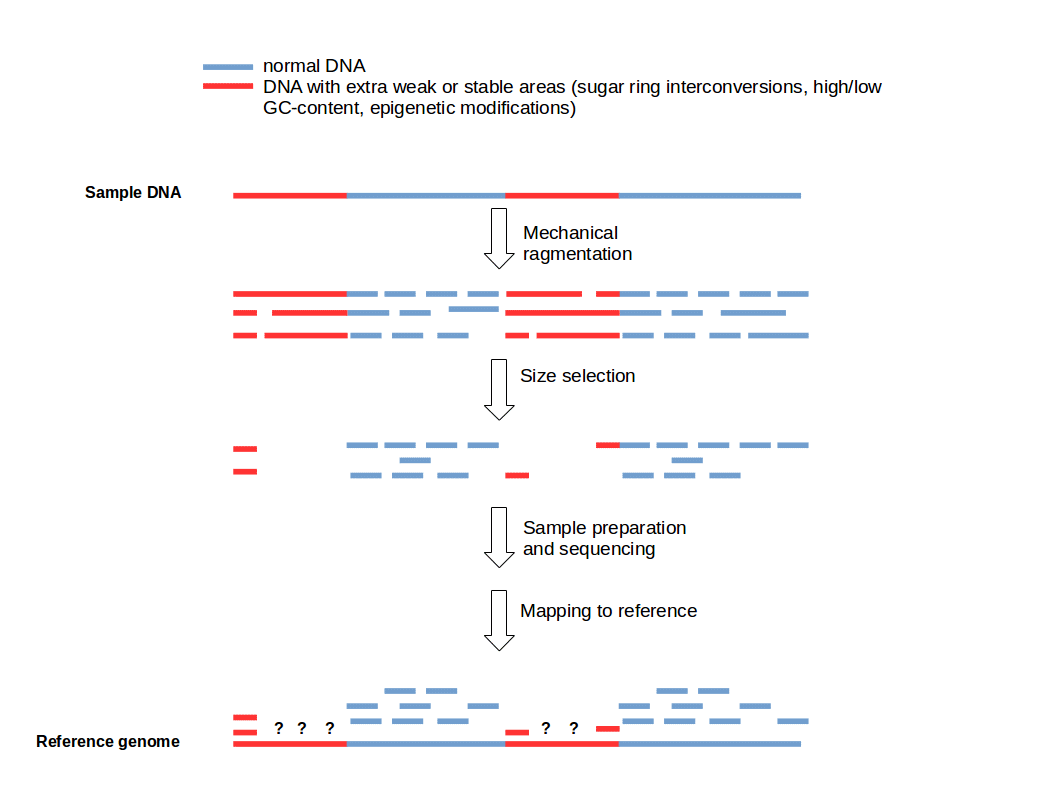
    Is there a bias after DNA fragmentation? What do you think?

    Cutting DNA into small fragments is a key preparation step for DNA sequencing with NGS technology. To reduce errors and increase reliability of the sequence information, every genomic region should be sequenced several times. This means that several copies of a target DNA have to be cutted in different ways to produce overlapping fragments to ensure an good coverage of the whole region of interest. This approach is based on the general idea that genomic DNA break-points are random and sequence-independent.

    But there is a problem... read more
    ecSeq Bioinformatics is Europe’s leading provider of hands-on bioinformatics workshops and professional data analysis in the field of Next-Generation Sequencing (NGS).
  • pmiguel
    Senior Member
    • Aug 2008
    • 2328

    #2
    And your evidence is? Would be helpful if you gave a review of the evidence of the six papers you reference rather than just stating conclusions.

    Some DNA damage/modifications could impact the replication of segments of DNA, of course. But it seems like coming up with a way to assay this would be tricky if you want to use sequencing as the assay. For instance, I presume there is some ligation-site bias in library construction that has nothing to do with the fragmentation method per se.

    --
    Phillip

    Comment

    • ecSeq Bioinformatics
      Senior Member
      • May 2012
      • 492

      #3
      Originally posted by pmiguel View Post
      For instance, I presume there is some ligation-site bias in library construction that has nothing to do with the fragmentation method per se.

      --
      Phillip
      We never claimed that the fragmentation is the only source of biases, did we? But it is a known source and researchers should be aware of it.
      Last edited by ecSeq Bioinformatics; 04-24-2017, 03:19 AM.
      ecSeq Bioinformatics is Europe’s leading provider of hands-on bioinformatics workshops and professional data analysis in the field of Next-Generation Sequencing (NGS).

      Comment

      Latest Articles

      Collapse

      • GATTACAT
        Reply to Nine Things a Sample Prep Scientist Thinks About Before Sequencing
        by GATTACAT
        Love this - good data definitely starts from good input, and poor input can only give relatively poor data. I particularly like the mention of Nanodrop/absorbance based methods for quantification. It's such a toss up if you'll get an accurate reading or what amounts to a randomly generated number, and a lot of library/sequencing related issues can be traced back to poor quant.
        07-01-2026, 11:43 AM
      • SEQadmin2
        Nine Things a Sample Prep Scientist Thinks About Before Sequencing
        by SEQadmin2


        I’m not a sequencing expert. I’m a purification scientist who uses NGS to evaluate workflows my group develops. With this perspective, we think about the sample first and the NGS workflow second. The sequencer is an exceptionally honest reporter, but it can only report on what you give it, so whether you get clean, interpretable data from an NGS workflow is largely determined before you begin.

        Here are nine questions we think about, in roughly the order they matter, before...
        06-18-2026, 07:11 AM

      ad_right_rmr

      Collapse

      News

      Collapse

      Topics Statistics Last Post
      Started by SEQadmin2, 07-02-2026, 11:08 AM
      0 responses
      23 views
      0 reactions
      Last Post SEQadmin2  
      Started by SEQadmin2, 06-30-2026, 05:37 AM
      0 responses
      23 views
      0 reactions
      Last Post SEQadmin2  
      Started by SEQadmin2, 06-26-2026, 11:10 AM
      0 responses
      23 views
      0 reactions
      Last Post SEQadmin2  
      Started by SEQadmin2, 06-17-2026, 06:09 AM
      0 responses
      55 views
      0 reactions
      Last Post SEQadmin2  
      Working...