Unconfigured Ad

Collapse
X
 
  • Filter
  • Time
  • Show
Clear All
new posts
  • Physalia-courses
    Member
    • May 2017
    • 88

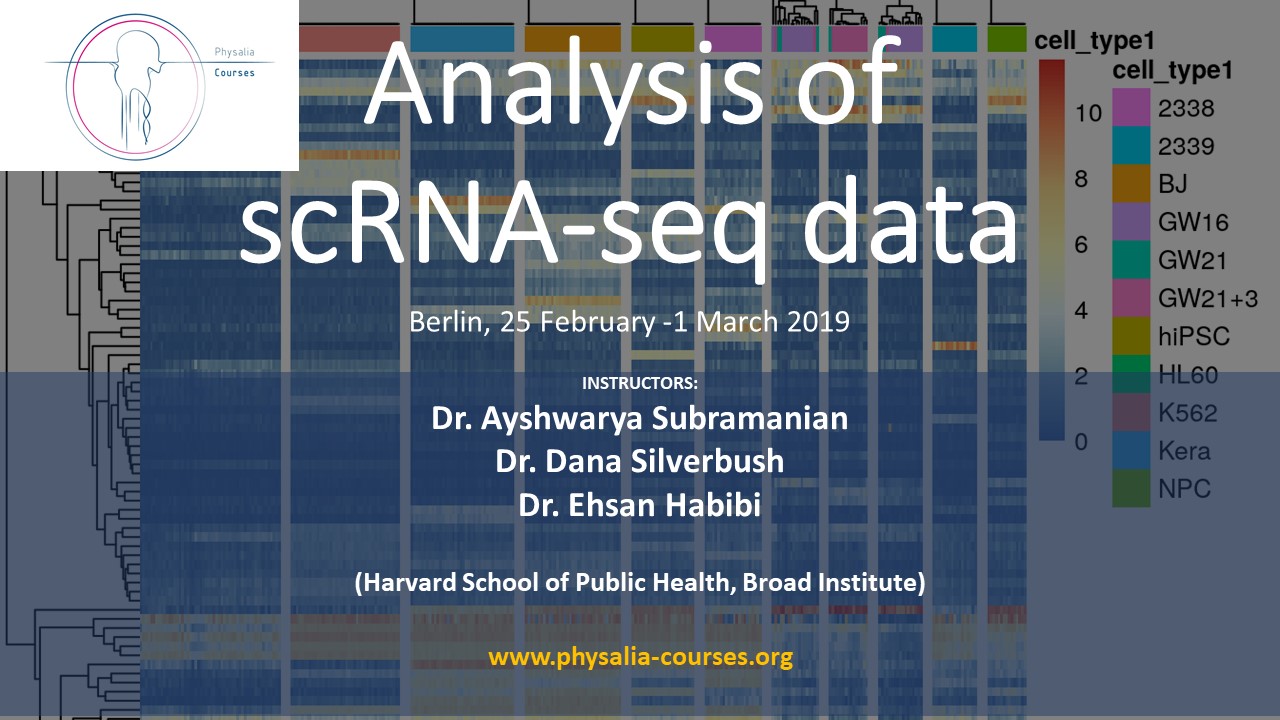
    Course. Analysis of single cell RNA-seq data.25 February-1 March 2019 in Berlin (Germ


    Analysis of single cell RNA-seq data


    When: 25 February-1 March 2019


    When: FU University in Berlin


    Instructors:

    Dr. Ayshwarya Subramanian (Harvard School of Public Health, Broad Institute, Dana-Farber Cancer Institute, US)

    Dr. Dana Silverbush (Harvard School of Public Health, Broad Institute, Dana-Farber Cancer Institute, US)

    Dr. Ehsan Habibi (Harvard School of Public Health, Broad Institute, Dana-Farber Cancer Institute, US)


    Course overview

    In recent years single-cell RNA-seq (scRNA-seq) has become widely used for transcriptome analysis in many areas of biology. In contrast to bulk RNA-seq, scRNA-seq provides quantitative measurements of the expression of every gene in a single cell. However, to analyze scRNA-seq data, novel methods are required and some of the underlying assumptions for the methods developed for bulk RNA-seq experiments are no longer valid. In this course we will cover all steps of the scRNA-seq processing, starting from the raw reads coming off the sequencer. The course includes common analysis strategies, using state-of-the-art methods and we also discuss the central biological questions that can be addressed using scRNA-seq.


    Course Format

    The course will be delivered over the course of five days. Each day will include a lecture and laboratory component. The lecture will introduce the topics of discussion and the laboratory sessions will be focused on practical hands-on analysis of scRNA-seq data. These sessions will involve a combination of both mirroring exercises with the instructor to demonstrate a skill as well as applying these skills on your own to complete individual exercises. After and during each exercise, interpretation of results will be discussed as a group. Computing will be done using a combination of tools installed on the attendees laptop computer and web resources accessed via web browser.


    Targeted Audience & Assumed Background

    This course is aimed at researchers and technical workers who are or will be analyzing scRNA-seq data. The material is suitable both for experimentalists who want to learn more about data-analysis as well as computational biologists who want to learn about scRNASeq methods. Examples demonstrated in this course can be applied to any experimental protocol or biological system.


    The requirements for this course are:
    • Working knowledge of unix (managing files, running programs)
    • Programming experience in R (writing a function, basic I/O operations, variable types, using packages).
    • Bioconductor experience is a plus.
    • Familiarity with NGS data and its analyses (using alignment and quantification tools for bulk sequencing data)

Latest Articles

Collapse

  • SEQadmin2
    Proteomic Platforms: How to Choose the Right Analytical Strategy to Improve Detection and Clinical Applications
    by SEQadmin2


    Proteomics platforms are evolving rapidly, with advances in mass spectrometry and affinity-based approaches expanding what researchers can detect and at what scale. As the field moves toward deeper proteome coverage and clinical applications, scientists face an increasingly complex landscape of tools. This article will explore how researchers are navigating these choices to find the right platform for their work.

    The systematic characterization of the human proteome has
    ...
    07-20-2026, 11:48 AM
  • SEQadmin2
    Advanced Sequencing Platforms Tackle Neuroscience’s Toughest Genomics Problems
    by SEQadmin2


    Genomics studies in neuroscience face a special challenge due to the brain’s complexity and scarcity of samples. Mapping changes in cell type and state using conventional next-generation sequencing methods remains challenging. Advances in technologies like single-cell sequencing, spatial transcriptomics, and long-read sequencing have opened the door to deeper studies of the brain and diseases like Alzheimer’s, amyotrophic lateral sclerosis (ALS), and schizophrenia.
    ...
    07-09-2026, 11:10 AM
  • SEQadmin2
    Cancer Drug Resistance: The Lingering Barrier to Rising Survival
    by SEQadmin2


    Cancer survival rates have significantly increased in the last few decades in the United States, reaching a combined 70% 5-year survival rate by 2021. Behind this number, there are years of research to find new therapies, drug targets, and early detection methods. But there is one core challenge that keeps slowing down these advances, and it’s about drug resistance.

    There is no single reason why many patients don’t respond to treatment as expected. Cancer is...
    07-08-2026, 05:17 AM

ad_right_rmr

Collapse

News

Collapse

Topics Statistics Last Post
Started by SEQadmin2, 07-20-2026, 11:10 AM
0 responses
16 views
0 reactions
Last Post SEQadmin2  
Started by SEQadmin2, 07-13-2026, 10:26 AM
0 responses
32 views
0 reactions
Last Post SEQadmin2  
Started by SEQadmin2, 07-09-2026, 10:04 AM
0 responses
43 views
0 reactions
Last Post SEQadmin2  
Started by SEQadmin2, 07-08-2026, 10:08 AM
0 responses
29 views
0 reactions
Last Post SEQadmin2  
Working...