
I've been making two-step amplicon libraries for years now with very few problems. The original amplicons are tailed with partial Nextera xt adapters and then I use Phusion HF to add the rest of the adapter with 6 cycles of PCR and KAPA Pure beads for cleanup. Recently, the yield has been much lower than expected and, rather than a pretty clean peak on the Bioanalyzer, there's been a lot of high molecular weight smearing. The samples labeled SPS01-07 are after the second round of amplication while the samples labeled Pre are before. Suggestions as to what might be going on?
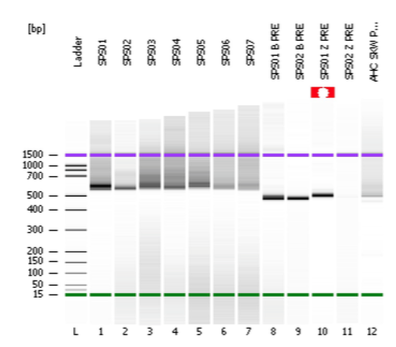
-
-
Not a good explanation, nevertheless: perhaps your stock of index primers is degrading or got contaminated? You might want to order a few fresh oligos and compare? -
Hey there, microgirl:
I was wondering if you tried what luc suggested and if this worked.
Also, do you have a low annealing temperature on your PCR cycles? I figure it's stayed the same, but since other things have been changed, maybe the thermocycler programming needs to be altered as well.
I've only been doing library prep for around 1.5 yr, but it surprised me how low the annealing temps in a lot of protocols are set to. We anneal at 50C!Comment


-
CRISPR/Cas9 sparked the gene editing revolution for both research and therapeutics.1 But this system still showed severe issues that limited its applications. The most prominent were the heavy reliance on PAM sequences, delivery limitations, double-stranded breaks that prompt unintended edits and cell death, and editing inefficiency (both in targeting and in knock-in reliability).
Despite this, “CRISPR helped turn genome editing from a specialized technique into...07-31-2026, 11:01 AM -
Proteomics platforms are evolving rapidly, with advances in mass spectrometry and affinity-based approaches expanding what researchers can detect and at what scale. As the field moves toward deeper proteome coverage and clinical applications, scientists face an increasingly complex landscape of tools. This article will explore how researchers are navigating these choices to find the right platform for their work.
The systematic characterization of the human proteome has...07-20-2026, 11:48 AM -
Genomics studies in neuroscience face a special challenge due to the brain’s complexity and scarcity of samples. Mapping changes in cell type and state using conventional next-generation sequencing methods remains challenging. Advances in technologies like single-cell sequencing, spatial transcriptomics, and long-read sequencing have opened the door to deeper studies of the brain and diseases like Alzheimer’s, amyotrophic lateral sclerosis (ALS), and schizophrenia.
...07-09-2026, 11:10 AM
Comment