Unconfigured Ad
Collapse
X
-
In all likelihood it means your RNA is degraded. However last month we saw a sample that was isolated using Qiagen RNeasy-mini that had what I took to be an odd pattern of degredation:

or, with the sizing turned on:

Not identical to your plot, but does contain what appears to be a non-standard rRNA degradation. The investigator said they were using this kit. Is that the one you are using?
--
Phillip
-
-
Your trace looks a bit like the 'Noisy peak' described in the troubleshooting guide (http://www.genomics.liv.ac.uk/animal...F/AGILENTM.PDF). I'd try giving everything a good clean and trying again....be sure there's nothing on your bench that might be causing vibrations.
JPC
Comment
-
-
Hi JPC,
Is your recommendation directed to me or eab?
In my case, the images I included were the 2nd time the samples were run. Here is the first time:

I have a 3rd run as well, if requested... We nearly always include an RNA sample of known good quality on each nano chip and it looked fine in each case. Our bioanalyzer is on a sturdy bench and not touching anything but the floor. We are in a sub-basement so vibrations are not generally an issue.
I can't speak to the details of EAB's run, but the shape there is not really similar to the "noisy electropherogram" example nor "broad peak". The bell shape is striking. But repeating the run -- especially after giving the sample a hard spin (in a microfuge, >10,000g for 5') and pippetting near the surface immediately afterwards to avoid particulates -- might be worth it.
--
Phillip
Comment
-
-
Sorry for not being clear, my comments were directed to ead. Obviously this is subjective but I do think there is a similarity to "Noisy Peak", though ead's trace is not as pronounced as the one shown in the manual.
Either way I would suggest a re-run. I have seen odd traces 'disappear' before now and if it is degradation you may see this develop hence confirming the 'diagnosis'.Last edited by JPC; 08-01-2012, 06:25 AM.
Comment
-
-
genomic DNA
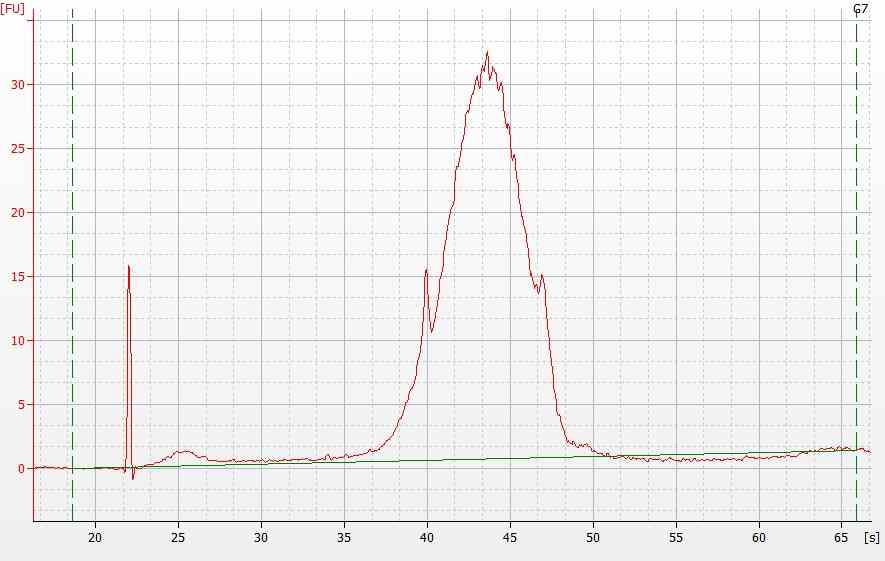
I've decided that this is genomic DNA contamination. I think I see two ribosomal peaks flanking that big bump. Sad to say, I know what degradation looks like, and that bump is too high MW to be degraded RNA. Perfect for normally-distributed fragments of human chromosomes sheared in spin-column purification.
Check this for comparison. http://www.chem-agilent.com/pdf/5989-0991EN.pdf
So now what should I do if I want to make mRNA libraries by standard Illumina protocol? Just go ahead with oligo-dT dynabeads? DNAse-treat? Something else?
Thanks!
Comment
-
-
So now what should I do if I want to make mRNA libraries by standard Illumina protocol? Just go ahead with oligo-dT dynabeads? DNAse-treat? Something else?
Thanks![/QUOTE]
My advice would be to DNase treat, it it is DNA contamination you run the risk of carrying some of it through library prep.
Comment
-
-
So you think I should DNAse treat even though I'm going to do poly-A purification?
If I do DNAse treat, will 94 degrees for 6 minutes (which I do for RNA frag anyway) be sufficient to inactivate the DNAse, or do I need to do additional inactivation? I'm worried about carrying the DNAse through and chewing up my library, but I don't want to do too much heating of the RNA before it's purified, either.
Comment
-
-
No, you want to DNAse treat, then column purify. Zymo sells kits with DNAse and the columns for cleaning up the reactions package in one kit.
By the way, I have a hard time believing that is genomic DNA. Genomic DNA will tend to be >50 kb unless treated very roughly. So I don't see any reason for it to run as a curve of that shape around that size. Could be wrong, though. Those RNA chips have some odd properties.
--
Phillip
Comment
-
-
OK, thanks Phillip, I appreciate your sharing your thoughts.
Why won't oligo dT purification on dynabeads be sufficient? Some DNA may copurify, but I would guess that most shouldn't. Any that does get through appears to be pretty large (running between the ribosomal RNA peaks). Will be tougher to incorporate it into a library and quite tough to cluster, no?
For that matter, won't oligo-dT dynabeads take out DNAse, too, if I choose to use it? I do two rounds of binding to the beads with an elution in between.
thanks
eb
Comment
-
-
We had a set of samples that were not properly DNased and the DNA carried through the library prep and was identified when we mapped the reads and found both genome and transcription coverage. My advice is always spend the time on getting the best library prep possible as it can be a very costly mistake not to.
To echo pmiguel I would highly recommend the Zymo columns we have done a head to head test of RNA columns with some of our species of interest and the Zymo columns consistently come out on top. In fact where there is a precipitation step we substitute a Zymo Clean and Concentrate column and have been getting much better final yields.
Comment
-
-
two votes in favor of DNAse -> i will DNAse.
now what about relying on two rounds of dynabeads oligo-dT purification, plus 6 minutes at 95 degrees to inactivate residual DNAse
i really don't want to do more columns because there are many samples and the amount of RNA is very low to start with
thanks!!
Comment
-
-
just to clarify, this is what Ambion says about its DNAse I
"Heat Inactivation of DNase I Some protocols suggest heating at 75°C for 5 min to inactivate DNase I [5]. A 10-minute incubation at 75°C completely inactivates Ambion DNase I at a concentration of 0.1 U/uL. If this is the preferred method of inactivation, add EDTA to a final concentration of 5 mM before heating"
seems to me that 6 minutes at 95, which is done for fragmentation of RNA anyway, will eliminate any DNAse activity not removed by Dynabead purification.
anyone disagree?
Comment
-
Latest Articles
Collapse
-
by SEQadmin2
I’m not a sequencing expert. I’m a purification scientist who uses NGS to evaluate workflows my group develops. With this perspective, we think about the sample first and the NGS workflow second. The sequencer is an exceptionally honest reporter, but it can only report on what you give it, so whether you get clean, interpretable data from an NGS workflow is largely determined before you begin.
Here are nine questions we think about, in roughly the order they matter, before...-
Channel: Articles
06-18-2026, 07:11 AM -
-
by SEQadmin2
Data variability is still an issue in sequencing technologies despite the advances in reproducibility and accuracy of these platforms. But the problem does not originate in the sequencing itself, but in the previous steps, before the sample reaches the sequencer.
The first step is collection, followed by preservation and sample preparation for analysis. Most scientists overlook those steps, but not being careful might just be skewing the experiment’s results.
...-
Channel: Articles
06-02-2026, 10:05 AM -
ad_right_rmr
Collapse
News
Collapse
| Topics | Statistics | Last Post | ||
|---|---|---|---|---|
|
Started by SEQadmin2, 06-26-2026, 11:10 AM
|
0 responses
14 views
0 reactions
|
Last Post
by SEQadmin2
06-26-2026, 11:10 AM
|
||
|
Whole-Genome Sequencing Traces Faroe Islands Ancestry to a North Atlantic Founder Population
by SEQadmin2
Started by SEQadmin2, 06-17-2026, 06:09 AM
|
0 responses
48 views
0 reactions
|
Last Post
by SEQadmin2
06-17-2026, 06:09 AM
|
||
|
Sequencing the Two-Toed Sloth Genome Reveals Jumping Genes Tied to Its Extreme Metabolism
by SEQadmin2
Started by SEQadmin2, 06-09-2026, 11:58 AM
|
0 responses
107 views
0 reactions
|
Last Post
by SEQadmin2
06-09-2026, 11:58 AM
|
||
|
Started by SEQadmin2, 06-05-2026, 10:09 AM
|
0 responses
125 views
0 reactions
|
Last Post
by SEQadmin2
06-05-2026, 10:09 AM
|

Comment