Unconfigured Ad

Collapse
X
 
  • Time
  • Show
Clear All
new posts
  • nucacidhunter
    Jafar Jabbari
    • Jan 2013
    • 1250

    #16
    I am just reading between the lines and assume that a pool of library was sequenced on both machines and a particular library yielded more reads on HiSeq than MiSeq. Some possible explanations:

    1- different pooling ratio
    2- differences in library size distribution
    3- residual adapter in some libraries resulting in increased index hopping

    I would do a demultiplexing of HiSeq reads with all index combinations to see if there has been unusual index hopping among some libraries (libraries with high index hopping will have less reads) and also pay attention to the number of unknown reads

    Comment

    • Innovelty
      Member
      • Sep 2012
      • 14

      #17
      On that note, what is an unusually high percentage of unknown reads?

      Comment

      • nucacidhunter
        Jafar Jabbari
        • Jan 2013
        • 1250

        #18
        Unknown reads source in indexed sequencing:

        1- PhiX
        2- indices that does not match those in sample sheet caused by base mis-match in excess of set numbers in bcl2 fastq. This is result of poor sequence quality due to over clustering or adapter/primer quality

        Unknown reads are high when using desalted primers for amplicon libraries

        Comment

        • misterc
          Member
          • Jan 2016
          • 46

          #19
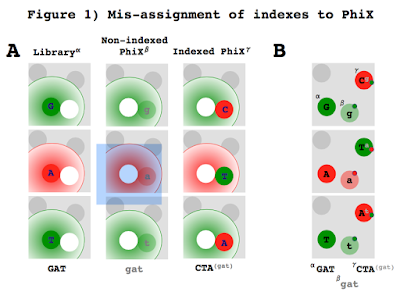
          IIRC, James Hadfield wrote up a very nice article on enseqlopedia showing how PhiX reads can get mis-associated with sample index sequences (when using Illumina's non-indexed PhiX) on patterned flow cells (like HiSeq 4K, X, and NovaSeq). If you do run PhiX with your samples on patterned flow cells at anything more than 1%, I'd suggest using indexed PhiX like the stuff SeqMatic sells. They'll even make you some PhiX with index sequences you specify (if desired).

          Comment

          • mama
            Junior Member
            • Sep 2008
            • 9

            #20
            Misterc: could you give me the link of James Hadfield article?

            Comment

            • misterc
              Member
              • Jan 2016
              • 46

              #21
              Multiplexing is the default option for most of the work being carried out in my lab, and it is one of the reasons Illumina has been so successful. Rather than the one-sample-per-lane we used

              Comment

              • HeinKey
                Member
                • May 2009
                • 21

                #22
                perhaps this question is asked before, but I don't understand the added value of dual indexing over single indexing anymore if both indices are unique in dual indexing. The highest possible complexity is then equal to highest complexity of single indexing.
                What do I miss?

                Comment

                • nucacidhunter
                  Jafar Jabbari
                  • Jan 2013
                  • 1250

                  #23
                  Originally posted by HeinKey View Post
                  perhaps this question is asked before, but I don't understand the added value of dual indexing over single indexing anymore if both indices are unique in dual indexing. The highest possible complexity is then equal to highest complexity of single indexing.
                  What do I miss?
                  Your statement is correct but UDI addresses another issue (index hopping) in patterned flow cells used in HiSeq 3000/4000 HiSeqX and NovaSeq to maintain fidelity of reads assigned to multiplexed libraries. Links in post #1 should give you some information on the issue.

                  Comment

                  • Innovelty
                    Member
                    • Sep 2012
                    • 14

                    #24
                    Sometimes, especially on the new Illumina flowcells, the indices get swapped around onto molecules they didn't originally belong to. With non-unique dual indices, where any combination of the index pool is potentially valid, that problem is invisible -- some of your reads *actually* belong to one library but have the indices for another library. With unique-dual-indexing, the problem still occurs, but it's not invisible -- any index-hopping or index-swapping will result in a read with an invalid combination of indices, and so it'll get kicked to the "Undetermined" set. You still "lost" that read, but it didn't get erroneously assigned to a different library.

                    Unique-dual-indexing *is* basically single-indexing, but you've got two barcodes, and the likelihood that both barcodes get swapped to something valid is practically nil.

                    Comment

                    Latest Articles

                    Collapse

                    • SEQadmin2
                      Beyond CRISPR/Cas9: Understand, Choose, and Use the Right Genome Editing Tool
                      by SEQadmin2


                      CRISPR/Cas9 sparked the gene editing revolution for both research and therapeutics.1 But this system still showed severe issues that limited its applications. The most prominent were the heavy reliance on PAM sequences, delivery limitations, double-stranded breaks that prompt unintended edits and cell death, and editing inefficiency (both in targeting and in knock-in reliability).

                      Despite this, “CRISPR helped turn genome editing from a specialized technique into
                      ...
                      07-31-2026, 11:01 AM
                    • SEQadmin2
                      Proteomic Platforms: How to Choose the Right Analytical Strategy to Improve Detection and Clinical Applications
                      by SEQadmin2


                      Proteomics platforms are evolving rapidly, with advances in mass spectrometry and affinity-based approaches expanding what researchers can detect and at what scale. As the field moves toward deeper proteome coverage and clinical applications, scientists face an increasingly complex landscape of tools. This article will explore how researchers are navigating these choices to find the right platform for their work.

                      The systematic characterization of the human proteome has
                      ...
                      07-20-2026, 11:48 AM
                    • SEQadmin2
                      Advanced Sequencing Platforms Tackle Neuroscience’s Toughest Genomics Problems
                      by SEQadmin2


                      Genomics studies in neuroscience face a special challenge due to the brain’s complexity and scarcity of samples. Mapping changes in cell type and state using conventional next-generation sequencing methods remains challenging. Advances in technologies like single-cell sequencing, spatial transcriptomics, and long-read sequencing have opened the door to deeper studies of the brain and diseases like Alzheimer’s, amyotrophic lateral sclerosis (ALS), and schizophrenia.
                      ...
                      07-09-2026, 11:10 AM

                    ad_right_rmr

                    Collapse

                    News

                    Collapse

                    Topics Statistics Last Post
                    Started by SEQadmin2, Yesterday, 07:41 AM
                    0 responses
                    12 views
                    0 reactions
                    Last Post SEQadmin2  
                    Started by SEQadmin2, 08-03-2026, 10:13 AM
                    0 responses
                    25 views
                    0 reactions
                    Last Post SEQadmin2  
                    Started by SEQadmin2, 07-31-2026, 02:55 AM
                    0 responses
                    39 views
                    0 reactions
                    Last Post SEQadmin2  
                    Started by SEQadmin2, 07-24-2026, 12:17 PM
                    0 responses
                    25 views
                    0 reactions
                    Last Post SEQadmin2  
                    Working...