Unconfigured Ad

Collapse
X
 
  • Time
  • Show
Clear All
new posts
  • FractalExpression
    Member
    • Feb 2011
    • 12

    #1

    Not a Big Deal, GRCh38: A Semi-Casual Comparison of the New Human Reference Genome

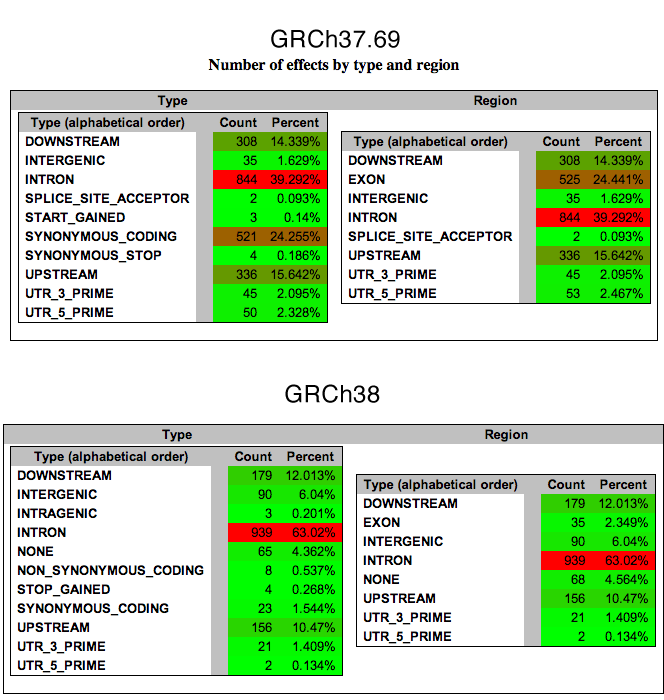
    Over christmas GRCh38, the newest human reference genome assembly, was released.Internally we have been using chromosome 20 of human reference builds to benchmark tools and pipelines with datasets. A BWA sequence alignment of the same dataset, generated on a HiSeq 2500, across the last major release GRCh37.69 and the new GRCh38 was performed.

    Quantifiably, GRCh38 is very similar to the later GRCh37 releases, showing a change rate of 1 change every 159,558 bases on 37.69 and 1 change every 156,779 bases on 38 for our chromosome 20 dataset.Ts/Tv ratios between the two alignments of the same data across the two references to be quite similar at 0.3527 and 0.3445, respectively. Back of the envelope math seems to give a Δ of +19,359 between GRCh37.69 and 38.
    Annotations have a large deviation, to be expected for now.

    Read the rest here: http://wp.me/pJHIj-nm
    Last edited by FractalExpression; 01-15-2014, 04:50 PM. Reason: one more figure
    Petri Dish Talk
  • Michael.James.Clark
    Senior Member
    • Apr 2009
    • 207

    #2
    A BWA sequence alignment
    Do you think this an appropriate aligner to use to fully take advantage of the new reference genome given its structure?

    It seems incorrect to take a tool optimized for the linear GRCh37, apply it to the graph GRCh38, and then state that the difference between 38 and 37 is "not a big deal".
    Mendelian Disorder: A blogshare of random useful information for general public consumption. [Blog]
    Breakway: A Program to Identify Structural Variations in Genomic Data [Website] [Forum Post]
    Projects: U87MG whole genome sequence [Website] [Paper]

    Comment

    • FractalExpression
      Member
      • Feb 2011
      • 12

      #3
      Discussing the primary assemblies themselves, that is not to include alternate regions available for 38, BWA is an appropriate choice- the aligner isn't necessarily trained for GRCh37.

      But you're right, how best to utilize the alternate regions, and updating current aligners to take advantage of that is a different question than a quick comparison for anyone considering a primary assembly remap of their data.
      Petri Dish Talk

      Comment

      Latest Articles

      Collapse

      • SEQadmin2
        Beyond CRISPR/Cas9: Understand, Choose, and Use the Right Genome Editing Tool
        by SEQadmin2


        CRISPR/Cas9 sparked the gene editing revolution for both research and therapeutics.1 But this system still showed severe issues that limited its applications. The most prominent were the heavy reliance on PAM sequences, delivery limitations, double-stranded breaks that prompt unintended edits and cell death, and editing inefficiency (both in targeting and in knock-in reliability).

        Despite this, “CRISPR helped turn genome editing from a specialized technique into
        ...
        07-31-2026, 11:01 AM
      • SEQadmin2
        Proteomic Platforms: How to Choose the Right Analytical Strategy to Improve Detection and Clinical Applications
        by SEQadmin2


        Proteomics platforms are evolving rapidly, with advances in mass spectrometry and affinity-based approaches expanding what researchers can detect and at what scale. As the field moves toward deeper proteome coverage and clinical applications, scientists face an increasingly complex landscape of tools. This article will explore how researchers are navigating these choices to find the right platform for their work.

        The systematic characterization of the human proteome has
        ...
        07-20-2026, 11:48 AM
      • SEQadmin2
        Advanced Sequencing Platforms Tackle Neuroscience’s Toughest Genomics Problems
        by SEQadmin2


        Genomics studies in neuroscience face a special challenge due to the brain’s complexity and scarcity of samples. Mapping changes in cell type and state using conventional next-generation sequencing methods remains challenging. Advances in technologies like single-cell sequencing, spatial transcriptomics, and long-read sequencing have opened the door to deeper studies of the brain and diseases like Alzheimer’s, amyotrophic lateral sclerosis (ALS), and schizophrenia.
        ...
        07-09-2026, 11:10 AM

      ad_right_rmr

      Collapse

      News

      Collapse

      Topics Statistics Last Post
      Started by SEQadmin2, 08-06-2026, 07:41 AM
      0 responses
      13 views
      0 reactions
      Last Post SEQadmin2  
      Started by SEQadmin2, 08-03-2026, 10:13 AM
      0 responses
      30 views
      0 reactions
      Last Post SEQadmin2  
      Started by SEQadmin2, 07-31-2026, 02:55 AM
      0 responses
      40 views
      0 reactions
      Last Post SEQadmin2  
      Started by SEQadmin2, 07-24-2026, 12:17 PM
      0 responses
      26 views
      0 reactions
      Last Post SEQadmin2  
      Working...