Unconfigured Ad

Collapse
X
 
  • Filter
  • Time
  • Show
Clear All
new posts
  • BioDynami
    Registered Vendor
    • Jul 2016
    • 41

    How fast is your NGS library preparation?

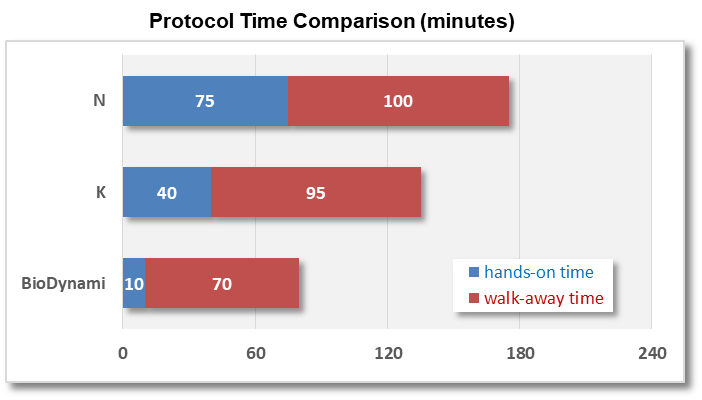
    Everyone wants NGS library preparation to be easy, simple, and fast. The reality is that protocol times for NGS library prep kits vary from vendor to vendor. There are several factors that are closely related, such as total protocol time, hands-on time and the number of steps. The table below shows the protocol times for library preparation spanning from 50 min to several hours. The protocol times shown here start from their beginning step to the end of adaptor-ligated library purification.


    It is no surprise that the protocol time is correlated with the number of steps. In addition, more steps mean longer hands-on time.


    Does speed matter?

    In the case of clinical sequencing, the answer is definitely yes. Speed is critical due to the nature of clinical urgency. Several clinical facilities are pushing hard to speed up their sequencing procedures, including NGS library preparation.

    Moreover, time saving is not the only benefit from a faster protocol. Work becomes simpler and easier as well.

    On the other hand, high speed doesn't means to sacrifice data quality or to increase cost. It’s always great when work is done in a fast, easy, and simple way with high quality and low cost.
  • huguesparri
    Member
    • May 2008
    • 97

    #2
    Hello,

    I've been looking throught the manual of your kits and in both of them, the final step is the following:
    "Amplification of the DNA library created from this kit may be necessary dependent on the type of your library adaptor and sequencing platform. Prior to proceeding to PCR or other downstream steps, quantify your library to determine whether the library is enough for your application. Amplify your library according to the instruction from your platform provider."

    Is this step mandatory for each library prep?
    And if yes, why didn't you include it in the library prep time?

    Thanks a lot for your answer,

    Hugues

    Comment

    • BioDynami
      Registered Vendor
      • Jul 2016
      • 41

      #3
      It is dependent on the adaptor you used. If you use Truseq adaptor, you can skip the PCR step. If paired end adaptor was used, then it is necessary to do the PCR. Many people like to pool samples together, they use the PCR step to add index barcodes for their samples.

      Comment

      • ECO
        --Site Admin--
        • Oct 2007
        • 1360

        #4
        Moving to Vendor Forum where this type of post belongs...

        Comment

        • luc
          Senior Member
          • Dec 2010
          • 469

          #5
          Would you have some example data?
          The protocol looks very similar to other single-tube library prep kits/protocols with the incubation times shortened a bit.

          Comment

          • BioDynami
            Registered Vendor
            • Jul 2016
            • 41

            #6
            Originally posted by luc View Post
            Would you have some example data?
            The protocol looks very similar to other single-tube library prep kits/protocols with the incubation times shortened a bit.
            BioDynami NGS DNA Library Prep Kit

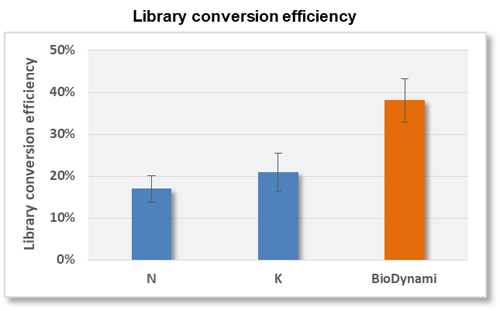
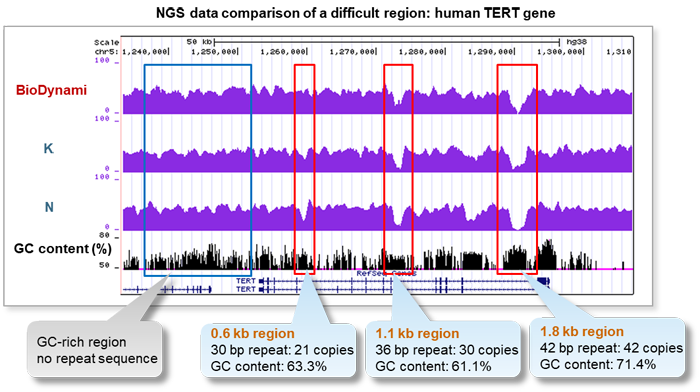
            We have compared with other kits. Please take a look at this:


            This is the library conversion efficiency comparison:


            This is the coverage comparison of a difficult region for whole genome NGS: High GC + repeat sequences
            Last edited by BioDynami; 09-08-2020, 08:00 AM.

            Comment

            • DNATECH
              Member
              • Mar 2015
              • 31

              #7
              Do the kits come with adapters? If so how many different barcodes?

              Comment

              • BioDynami
                Registered Vendor
                • Jul 2016
                • 41

                #8
                Originally posted by DNATECH View Post
                Do the kits come with adapters? If so how many different barcodes?
                Adaptors are not included in the kits because that will give our customers more flexibility to use different types of adaptors.

                Any dA-tailed adaptor will work with our kits.

                If you have multiple samples, you can construct the libraries using regular illumina paired end adaptor, then add barcode information to the libraries by PCR using index primers.

                Comment

                • gringer
                  David Eccles (gringer)
                  • May 2011
                  • 845

                  #9
                  ONT 1D fragmentation kit: 15 minute sample prep, 2 mins after loading to first base-called result.

                  Comment

                  • luc
                    Senior Member
                    • Dec 2010
                    • 469

                    #10
                    ... and once ONT works reliably and generates more sequence data than pain and suffering we would all like to switch.

                    Originally posted by gringer View Post
                    ONT 1D fragmentation kit: 15 minute sample prep, 2 mins after loading to first base-called result.

                    Comment

                    • gringer
                      David Eccles (gringer)
                      • May 2011
                      • 845

                      #11
                      How much sequencing data do you need? With the R9 run I did yesterday, I got 45,000 reads of ~600bp in about an hour, mean 1D accuracy of 85%, mean 2D accuracy of 91%. Bioinformatics time for preliminary amplicon read quantification (using BWA) was about half an hour.

                      Current (R9.4, as of today) flow cells generate 5-10Gb per run, with mean accuracy of 90-97% depending on sequencing speed and 1D/2D choice. Cost per run is still the same ($600-$1000 USD, depending on how many flow cells are purchased in bulk), which is now much cheaper than PacBio and similar to MiSeq due to increased run yield.

                      Comment

                      • luc
                        Senior Member
                        • Dec 2010
                        • 469

                        #12
                        R9.4? Please keep us updated. ONT tends to have a long lag time between their announcements and the performance delivered (years).

                        Comment

                        Latest Articles

                        Collapse

                        • SEQadmin2
                          Nine Things a Sample Prep Scientist Thinks About Before Sequencing
                          by SEQadmin2


                          I’m not a sequencing expert. I’m a purification scientist who uses NGS to evaluate workflows my group develops. With this perspective, we think about the sample first and the NGS workflow second. The sequencer is an exceptionally honest reporter, but it can only report on what you give it, so whether you get clean, interpretable data from an NGS workflow is largely determined before you begin.


                          Here are nine questions we think about, in roughly the order they matter, before...
                          06-18-2026, 07:11 AM
                        • SEQadmin2
                          From Collection to Sequencing: Why Sample Preparation and Preservation Define Sequencing Data
                          by SEQadmin2


                          Data variability is still an issue in sequencing technologies despite the advances in reproducibility and accuracy of these platforms. But the problem does not originate in the sequencing itself, but in the previous steps, before the sample reaches the sequencer.


                          The first step is collection, followed by preservation and sample preparation for analysis. Most scientists overlook those steps, but not being careful might just be skewing the experiment’s results.
                          ...
                          06-02-2026, 10:05 AM
                        • SEQadmin2
                          Single-Cell Sequencing at an Inflection Point: Early Impacts of New Platforms and Emerging Trends
                          by SEQadmin2


                          With the launch of new single-cell sequencing platforms in 2026, the field stands at an exciting inflection point. This article surveys the most impactful advances in the field and discusses how they’re reshaping research in cancer, immunology, and beyond.


                          Introduction

                          Single-cell sequencing technologies have undergone remarkable advances over the past decade, transitioning from low-throughput experimental approaches to highly scalable platforms capable of...
                          05-22-2026, 06:42 AM

                        ad_right_rmr

                        Collapse

                        News

                        Collapse

                        Topics Statistics Last Post
                        Started by SEQadmin2, 06-17-2026, 06:09 AM
                        0 responses
                        22 views
                        0 reactions
                        Last Post SEQadmin2  
                        Started by SEQadmin2, 06-09-2026, 11:58 AM
                        0 responses
                        40 views
                        0 reactions
                        Last Post SEQadmin2  
                        Started by SEQadmin2, 06-05-2026, 10:09 AM
                        0 responses
                        47 views
                        0 reactions
                        Last Post SEQadmin2  
                        Started by SEQadmin2, 06-04-2026, 08:59 AM
                        0 responses
                        49 views
                        0 reactions
                        Last Post SEQadmin2  
                        Working...