Unconfigured Ad

Collapse
X
 
  • Filter
  • Time
  • Show
Clear All
new posts
  • scrosby
    Director, GTAC, Washington U.
    • Nov 2009
    • 32

    RNA-seq in the NovaSeq

    The smallest S1 kit is 100-cycles. With RNA-seq this results in a choice of single-end (100bp) or paired-end (2x50).

    For the detection of splice junctions in, say, 300bp fragments...
    • Perhaps there is a lower false positive rate when you have actual evidence of the junction in a read, which would argue for SR.
    • Perhaps more (~3x as many?) junctions can be detected through a combination of direct detection and imputation by doing PE reads.

    Has any definitive work on SR vs PE RNA-seq been published? I looked around a bit and found some chatter, but nothing peer-reviewed that directly addresses this question.
  • scrosby
    Director, GTAC, Washington U.
    • Nov 2009
    • 32

    #2
    260 views...NO replies!!
    Maybe a more extensive search would have revealed nothing!

    Comment

    • Markiyan
      Senior Member
      • Sep 2010
      • 126

      #3
      I would go for PE reads in this case.

      Assuming yours RNAseq libraries are compatible with patterned flowcells:


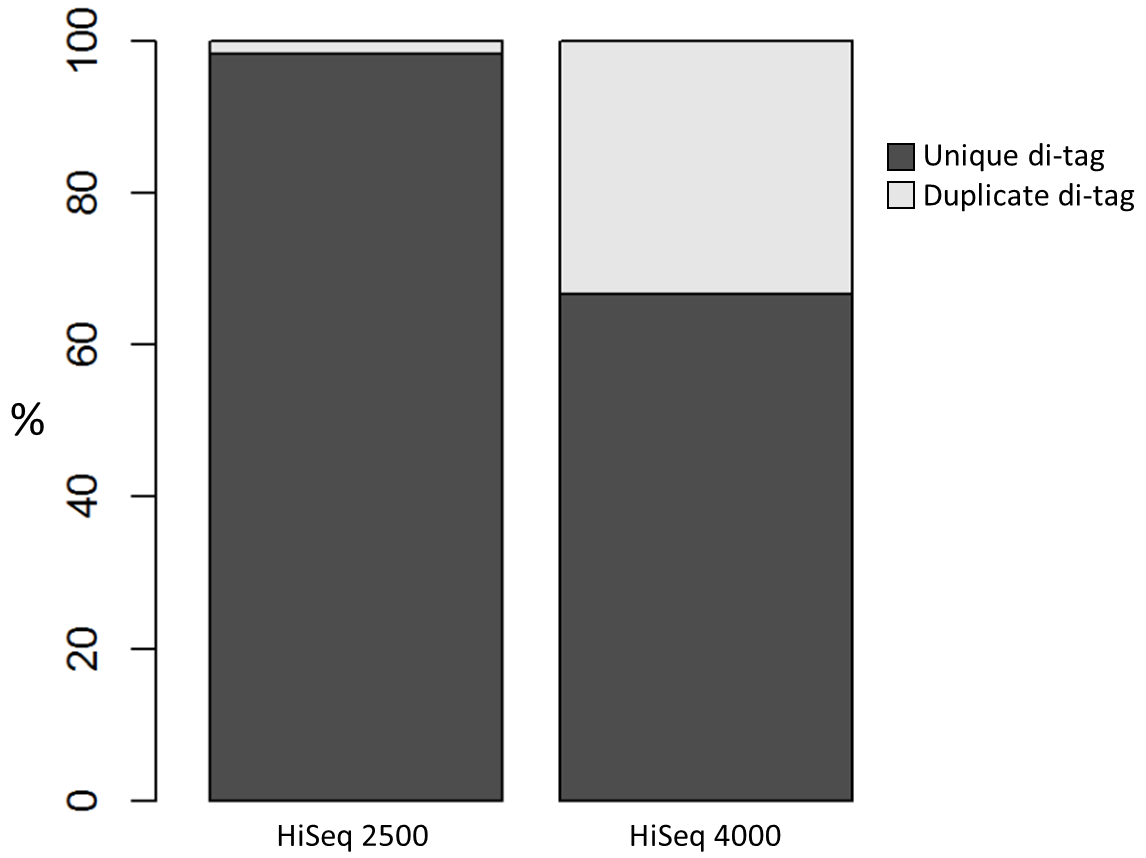
      The latest Illumina sequencers – such as the HiSeq X, HiSeq 3000 and HiSeq 4000 – use patterned flow cells to enable the discrimination between much more densely packed DNA clusters. While such technology substantially increases the number of reads generated per sequence run, this innovation may lead to an increased number of duplicates, thereby negating the improved yield and making subsequent data analysis potentially more difficult. Further investigation shows that these putative sequencing duplicates are generally in close two-dimensional proximity on a flow cell, which may provide an opportunity to develop bioinformatics solutions to identify and discard such artefacts.


      and you use dual unique barcodes for demultiplexing to reduce index crosstalk, I would go for 2x50bp reads.

      But given you probably would like to also see novel splice junctions in addition to annotated ones one may go with longer reads - use a 200cycle or 300cycle kit in PE mode, than use FLASH or similar tool to preassemble paired reads, and this would give you both "SR"(combined) and PE(non-combined) reads from yours 300bp library.
      The longer the reads, the higher the "SR"(combined) proportion would be. and the more resilient it should be to the repeats.

      PS: if you can find a nextseq 2x150 bp RNASEQ experiment in the SRA, than you can generate both 1x100 and 2x50bp reads from it in silico by trimming, and than compare the results after analysis by your pipeline.

      PPS: If you have 200 or 150 cycle S1 kit - run it as 2x100 or R1:100+R2:50 and generate both 100 SE and 2x50PE datasets from the same run by doing custom trimming. This should give you a very good idea which method would be the best in your case for future experiments.

      Comment

      Latest Articles

      Collapse

      ad_right_rmr

      Collapse

      News

      Collapse

      Topics Statistics Last Post
      Started by SEQadmin2, Yesterday, 10:09 AM
      0 responses
      10 views
      0 reactions
      Last Post SEQadmin2  
      Started by SEQadmin2, 06-04-2026, 08:59 AM
      0 responses
      21 views
      0 reactions
      Last Post SEQadmin2  
      Started by SEQadmin2, 06-02-2026, 12:03 PM
      0 responses
      27 views
      0 reactions
      Last Post SEQadmin2  
      Started by SEQadmin2, 06-02-2026, 11:40 AM
      0 responses
      22 views
      0 reactions
      Last Post SEQadmin2  
      Working...